.

Pages

Showing posts with label ayamku. Show all posts

Friday, July 1, 2011

Ayamku

Yang kat atas tu  adalah ayam sabung putih...bapaknya dulu warna merah. Tak terniat pun mahu sabung ayam..Dulu waktu mula-mula pelihara ayam cuma untuk lepas stress. Masa aku biarkan ayam betina aku berkeliaran. Ayam sabung orang sebelah perkosa ayam aku...Adoh..dh tu dapatlah hasil ayam ni. Biasanya orang tengok ayam sabung warna merah. Tapi ni special sikit. Warna putih. Umurnya lebih kurang 6 bulan. Ramai jugak yang bidak harga ayam ni. Buat masa ni harga tertinggi bidaan adalah RM60.. tapi aku tak nak jual. sebab pertama. Mereka beli untuk judi ayam dan kedua memang aku taknak jual..hahaha...buat koleksi.


Yang kat atas tu ayam selasih. masa beli dulu kecil je. Bila besar. besar pulak dia.. Dulu aku beli RM5 seekor..sekarang ni RM6 seekor. Orang kata ayam ni mahal. mungkin juga. bagi aku, ayam ni jenis yang unik.. Sebab jari dia ada 5..kaki berbulu dan warna menarik.. Asal ayam ni dari china. disana ayam ni dipanggil pheonix. yang putih dipanggil white pheonix. tapi kat Malaysia. Kita panggil ayam selasih bulu lembut. Kepala ayam ni seperti burung helang, dagingnya berwarna hitam sekali dengan tulangnya. Aku cadang mahu pelihara ayam ni banyak2 sebab keunukannya.

Yang ni pulak anak ayam serama. Hari ni usianya 5 hari. Kiut!!!! Aku mahu picit dia sampai mati...tapi aku sayang dia...Sebenarnya ayam ni bukan aku yang punya. Memandangkan isteri tuannya baru je melahirkan ank. dia abaikan anak ayam ni. jadi akau lah yang bela.. bapak dia cantik. Berbulu merah dan berekor jumtai.

Sekian saja jejak ayam kali ini. jangan tanya apa puspose aku pelihara ayam k... Sebab aku pelihara pun macam org kumpul stem... Macam tak da matlamat... Kalau orang nak beli aku jual..kalau orang nak makaan..sembelih la... hahahaahaahahahaha


Wednesday, May 11, 2011

Anak ayam-ayam kampung


Assalamua'laikum pembaca sekalian. Kali ni saya nak berkongsi sedikit tentang haiwan peliharaan saya ni iaitu AYAM. Hahahaha... ayam ni dah ibarat kawan paling rapat saya dah.... hari-hari saya pergi jenguk diaorang kat reban. Yang video tu adalah rakaman bertarikh 23/4/2011. Lama juga dah tu. Semua anak ayam tu besar-besar dah. Semuanya ayam kampung milik saya ada 16 ekor semuanya. Ayam kacukan daging hitam ada 2 pasang. Semalam ada 9 biji telur ayam menetas. So, bertambahlah bilangan kawan ayam ni...hahaha... bila cakap tentang ayam ni, merekalah tempat akau melepaskan segala stress aku. Bila aku rasa stress, aku akan masuk dalam reban. Raban ayam aku bersih tau. Hari-hari aku bersihkan. Sebelum aku pergi kolej, aku akan bersihkan ayam-ayam aku. Bagi diaorang makan dan tukar air minuman diaorang. Air minuman diaorang mesti bersih. Nanti, bulu diaorang cantik. Aku dah kenal pasti beberapa anak ayam yang ada potensi untuk dijual dengan harga RM 200 seekor. huhuhu... mahal tu. Tu baru ayam kampung.
Belum lagi ayam serama kan. Buat masa ni aku belum ada benih ayam serama. Bimbang juga nak pelihara ayam tu. Sebab ayam yang aku pelihara sekarang ni jenis ayam sabung. Nanti habis mati diaorang kena sabung. Huhuhu... Tentang ayam kacukan kepunyaan aku, seronok tengok diaorang. Badan diaorang besar dan tegap. Kalau besar nanti ayam sabung pun belum tentu hidup kalau aku sabungkan. Jangan salah faham ye. Tak delah aku sabungkan ayam. walaupun ramai yang ajak aku sabung ayam. Pernah ayam aku terlepas. Dia bunuh seokor ayam sabung orang. Dia punya taji panjang 2 inci. Tajam macam jarum. Bukan setakat ayam, manusia pun sampai berbalut ayam aku sabungkan. tapi yang hairannya, ayam-ayam aku tu tak pernah pulak sabung aku. Takut kot.....kalau dia sabung aku, aku tak kasi makan. hahahaha... itu saja lah berita tentang ayam .........

Tuesday, April 12, 2011

Ayam-ayamku

Chicken is known as the chicken cross the black content

Chicken eggs 3 days old

This chicken is going to be my champion fighting cocks! age of about 4 months

It is also the father of all my chickens
It is the sons of my chickens are 3 weeks old ... 16 pieces are all there ...

Sunday, April 3, 2011

Langkah penting menyambut anak ayam incubator

Salam semua,
(RUJUKAN UNTUK MEREKA YG BARU MENCUBA)
dengan pertambahan kesedaran penggunaan incubator dikalangan kelak kebelakangan ini, kita sering terlupa untuk belajar cara2 mendidik anak ayam ini apa bila menetas kelak. Apa yang dipikirkan dengan adanya incubator ini, bilangan anak yang dihasilkan diladang akan bertambah dan terancang. Hati sangat gembira kerana si ibu dapat menghasilkan lebih banyak telur untuk keluaran setahun. telur yang dikutip dijaga dengan baik dan melaksanakan semua peraturan dan tatacara penggunaanya, bila sampai masanya anak ayam pun menetas dengan jayanya.. sedikit perubahan pelik seperti kecacatan tidak dapat diterima seperti merasakan incubator ini tidak berkesan atau rosak..setiuasi ini sangat biasa bagi mereka yang kali pertama menggunakan incubator.. namun dari hari kehari pengalaman dapat ditimba dan semakin mahir denganya.. Cuma yang peliknya semua anak ayam yang lahir nampak tak sihat dan mati tak sampai sebulan dari ditetaskan? macam2 dilakukan namun tak berjaya.. setelah peratusan hidup melebihi umur 3 bulan menurun dengan mendadak, timbul kesangsian dalam diri tentang incubator sehingga meng'cop'kan semua anak incubator tidak bagus dan sangat lemah.. namun kita tidak sedari bahawa dgn menggunakan incubator, kita telah membuat penjanjian tak ramsi untuk menjadi ibu angkat bagi setiap ekor anak yg keluar..

Sebenarnya tugas gantian yang kita terima perlu dilakukan dengan bijak dan berkesan supaya semua anak ayam yg dibesarkan dididik dgn baik serta boleh berdikari. Segala keperluan semuajadi seekor anak ayam perlu dipenuhi dengan meniru persekitaran atau kebiasaannya.. Oleh itu espek penjagaan anak untuk anak ayam bagi sebulan pertama sangat kritikal, sama kritkal sebiji telur didalam incubator. Penyedian brooder yang baik sangat mambantu tugasan ini.
cara mudah membuat brooder

teman menggunakan brooder ciptaan teman yang sangat jimat, kalis air dan mudah dibasuh, saiz sederhana sesuai dgn saiz kapasiti incubator teman dan murah. kita hanya perlu menyediakan keperluan asas sahaja untuk membuatnya, gambar pertama di baris atas adalah 5 bijik kotak plastik pvc yang teman beli di pasaraya semasa ada offer dulu. anda perlu bersihkan kotak ini dan lapikkan dengan surat khabar lama untuk memudahkan kita membersihkan bila perlu. kemudian satu lapisan tisu diletakkan diatas surat khabar tadi. Tujuan tisu ini adalah untuk memberi lebih cengkaman kepada anak ayam ini ketika kali pertama menjejakkan kaki selepas keluar dari incubator. ketika ini kaki anak ayam sangat lemah dan sebarang tekanan keterlaluan atau kegagalan untuk berdiri tegak akan mencacatkan anak ayam ini selamanya. Tisu ini hanya digunakan sekali dan dibersihkan atau dikeluarkan selepas 3 hari keluar dari incubator dan diganti dengan lapik biasa.


kemudian sediakan bekas air biasa yang diisi dengan air biasa dengan suhu bilik, bukanya air suam atau air sejuk.. anak ayam seharusnya tidak mendapat kejutan suhu semasa kali pertama anak ini minum. Kita cuba adaptasikan persekitaran anak ayam ini mula2 minum semasa dididik oleh ibunya, adakah disediakan sebarang air suam atau air sejuk untuk anak ayam.. mereka biasanya minum air pada suhu bilik atau air biasa yang berada diluar rumah. kemudian taburkan dedak dengan kuantiti sedikit di atas lapisan tisu tadi dan bukanya dalam bekas makanan ayam biasa. ini hanya dilakukan untuk kali pertama ayam ini makan.


Lampu berkuasa 5 watt digantung didalam bekas plastik ini dan seeloknya ketinggian mentol ini untuk kali pertama atau hari pertama adalah sedikit sahaja tinggi dari kepala anak ayam ini. kiranya kalau nak diukur dengan jarak adalah hanya seluas ketebalan batang pensel sahaja. kalau anda perhatikan untuk kali pertama anda meletakkan anak ayam ini, mereka berkecenderungan untuk berkumpul serapat mungkin bersama dan berkumpul dibawah lampu. kelakuan ini bukannya kerana kesejukan semata atau boleh kita elakkan dgn menambah watt lempu tapi kelakuan ini adalah tindak balas ayam untuk berada dalam pelukan sesuatu untuk merasa selamat. dalam keadaan tabie.. anak ayam akan duduk diam dalam kepak ibunya sehingga berasa cukup kuat untukkeluar sekejap dan berterusan sehingga berani untuk bermain disekeliling ibunya. ketinggian lampu diubah mengikut minggu usia anak ayam ini, pada penghujungnya sebulan jarak mentol dengan anak ayam seharusnya pada setinggi 4 inci atau lebih demi melatih anak ayam 'memahami persekitaranya'

setelah semua persiapan siap, kita bolehlah memindahkan anak ayam ini dari incubator, sebaiknya pindahkan sedikit demi sedikit dahulu dan jgn biarkan ank ayam ini terlalu lama diluar tanpa bantuan cahaya.. anak ayam yang sudah cukup cergas dan dapat berdiri tegak dipindahkan ke brooder. mulut atau muncung paruh anak ayam itu direndamkan sedikit dibekas air supaya anak ayam ini tahu terdapat sumber air, anak ayam dibuarkan merasa air itu seketika dan biarkan dia mencari air itu sendiri dalam proses'belajar' berdikari. anak ayam akan mula mematuk2 makanan diatas lantai dengan sengaja kerana nalurinya. tujuan menaburnya untuk meningkatkan kebarangkalian anak ayam ini merasa dedaknya yang yang pertama. kemudian boleh lah kita meletakkan bekas didalam brooder ini.

anak ayam dibiarkan berada dalam lingkungan cahaya mentol sepanjang masa semasa berusia dibawah 2 minggu dan mpada waktu malam sahaja selepas itu.. setelah usia mencecah 1 bulan lampu hanya dipasang sekiranya hari hujan atau cuaca sejuk.. anak ayam kampung yang berusia 1 bulan sebenarnya masih kecil dan belum boleh berdikari untuk hidup bersendirian. sebolehnya lanjutkan usia anak ayam didalam brooder ini sehingga sebulan setengah(bagi ayam kacuk biasanya pada umur ini ayam sudah besar dan berbulu separuh penuh) selepas yakin dgn kecergasan anak ayam kita kena pindahkan ke reban asuhan luar rumah atau didalam reban..

Sumber : http://citypullagro.blogspot.com/2009/10/langkah-penting-menyambut-anak-ayam.html

Thursday, March 31, 2011

Anak-anak ayam kampung


Hohoho...anak-anak ayam yang aku ada... setakat ni adalah dalam belasan ekor...mau p tambah lagi nanti..... mau jalan-jalan kat kampung-kampung cari baka baik punya...huhuh... ni gambar aku tangkap guna hp...bab tu lah tak cantik sangat..

Ayam Kampung

Chicken is the original species of wild birds like partridge, were subsequently reared and tame. There is an opinion saying the original chicken partridge. In English terms, it's called "free-range-chicken" because the pattern of free-living life to feed on its own.

At present, the chickens are gaining attention as a deck of delicious and nutritious meat. Many farmers in growing numbers of chickens on a commercial undertaking. There for the supply of meat, eggs and fry chicken.

Sumber : http://shawnagrofarm.wordpress.com/2010/04/02/cara-mudah-menternak-ayam-kampung-ori/

Wednesday, March 30, 2011

Ayam sabung


Fighting cocks (gamecock) is quite famous among the foot-kai ayam.Ayam fighting games and fans are willing to fight until the chicken is also known as fighting mati.Ayam laga.ayam bangkok chicken fighting cocks and the east coast known as the chicken is well known, especially in Kelantan Baek and the besut in terengganu, but should be remembered each different from the fighting cocks in every state and negara.Di Thai (Siamese) and peninsular Malaysia fighting cocks seemed to either of the types of genes and the way his complaint said .. some fighting cocks from peninsular Malaysia are imported from bangkok (thai), and fighting cocks is impossible not seem to sama.Manakala in Sabah, Sarawak and some in Indonesia is different from fighting cocks fighting cocks fighting cocks from Bangkok because it was too small and the chicken-like when (Serama) and chicken diwar2kan forests and fighting cocks are from Myanmar (not historical facts). sebagi Chicken Chicken is also known as its spine connected to the knife blade around 5'inci and adunya not take too long antra 3.4 minutes.

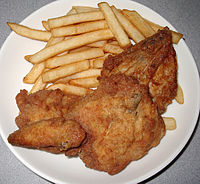
Ayam goreng

Fried chicken is chicken which is dipped into the coating, then deep fried, pan fried or pressure fried. Coating the meat retain water while soaking the chicken fat. Chicken bones can be removed and / or peeled, or otherwise.

Fried chicken cooked with the most pressure fryer, as this is the fastest method of preparation. The water evaporates and the chicken out of the oil in a closed chamber, as well as increased pressure and lowers the temperature required to cook. Vapors are also cook the chicken moist while ensuring that the contents in the soft crunchy coating.

Sumber : http://ms.wikipedia.org/wiki/Ayam_goreng

Ayam Serama

A male Serama in its native country of Malaysia
The Serama (Malay Ayam Serama), also called the Malaysian Serama is a bantam breed of chicken originating in Malaysia within the last 50 years.

History

The Malaysian Serama is a relatively new breed. It's exact origins and history are unclear. There are legends of it being descent from a chance cross between a pigeon and chicken. Other stories of the birds derived from a gift of some small chickens by the King of Thailand to a local sultan in ancient times. It was almost certainly developed in Kelantan Province in Malaysia (near Thai border). Small chickens have always been popular pets in this area and are often referred to as "ayam katik" (pygmy chickens) and "ayam cantik" (pretty chickens).
The modern breed is attributed to the efforts of Wee Yean Een from Kelantan, who named the breed "Serama" after Raja Sri Rama, a character in the Wayang Kulit (or shadow puppet plays). The breed was first exhibited in 1990 and became an instant hit. The year 2000 was the peak in popularity in Malaysia. The breed was hit hard by the Asian bird flu epidemic in 2004 when over 50,000 birds were culled amid government concerns. However, the breed has bounced back and is regaining popularity again in Malaysia.
There are no written standards for the breed in Malaysia, nor is there any tradition of poultry clubs. Much information is understood by breeders and disseminated by word of mouth. Many breeders have a style or type that they breed to, but often breeders keep several styles. These styles are often names given by breeders to describe a blood line of a champion (e.g. Husin, Mat Awang), but may also be more general shape, characteristics or behaviour (e.g. slim shape, ball shape, dragon shape, head shaking behaviour, robot style). Hence there is quite a lot of diversity in Malaysia. All the different styles compete against each other in open table top competitions (often described as "beauty contests") and scored by several judges.
The Malaysian Serama is not constrained by a single set standard in it's homeland, this is why the Malaysian Serama has evolved so much in such a short timespan and still continues to evolve there today. There have been calls for an official body to step in and set standards for the various styles. However, some Malaysians have argued that a standard should not be set because it would limit the breed. One influential Serama breeder making the analogy with the automobile: "The designs for the perfect automobile is not set out by government, so why should they specify one for Serama chickens. Technology moves forward and we learn and design new things. So why should it be any different with chickens."

In America

In 2001, the Serama was first imported to the United States by KJ Theodore of Illinois. Jerry Schexnayder of Louisiana imported the second group. The Theodore import was of better quality, containing a gene for extreme smallness. The Schexnayder import was larger, but lacked such a gene. All Seramas in the United States are direct descendants of these original imports. The Serama was then promoted by an organization founded by Jerry Schexnayder, the main profiteer in serama, known as The Serama Council of North America (SCNA). This council first introduced the Serama to North America in various National Poultry shows. In the spring of 2004 the Serama had reached a milestone in which it had its own Serama only-show known as the Cajun Classic in Baton Rouge, Louisiana. At this point the Serama is still in a critical point of establishment. Now with the Serama population slowly rising, it is just starting to make a reputation for itself.
Seramas are in the process of acceptation by the American Poultry Association and the American Bantam Association, with the first qualifying meets being held this year. Seramas in the U.S. have been the subject of controversy with regard to what ideal type or standard should be pursued. Two schools of thought have been pursued in breeding of the Serama in whether it should remain completely Malaysian in style or whether it should be adapted to American taste. The second ideology has become the leader in Serama breeding in America, eclipsing the "race for acceptation" in the year 2010 with the first qualifying meets.

In Europe

Seramas were initially imported into the UK around 2003-2004. Birds were imported from both America and directly from Malaysia. The foundation Serama flock in the UK consisted of only a few dozen birds. In 2005, a small group of Serama owners and enthusiast decided to form the Serama Club of Great Britain, the first Serama club in the UK. They established the standard for the Serama breed for the UK. Eventually in 2008, the club was officially recognised as the affiliated breed club of the Poultry Club of Great Britain.
Seramas are still relatively rare and expensive in much of mainland Europe. The Netherlands probably has the largest number of Seramas outside the UK. Most of the stock in the Netherlands are descendent from birds/eggs imported from America and from the UK.

General characteristics

They are the lightest weight chicken in the world. Typically under 500g, but with even smaller birds that are under 250g being bred in it's native Malaysia. The Serama are characterized by their upright posture, full breast, vertical tail feathers held upright and tight up to the body and vertical wings held down nearly touching the ground. In Malaysia they are described as brave warriors and archangel chickens, because of their very human like appearance.

Breeding

Overall Seramas are a fairly easy bird to breed. After laying an egg it takes approximately 19–21 days for the chicks to develop and hatch. Chicks are more susceptible to cold temperatures compared to other breeds because of their relative small size. After hatching it takes about 16–18 weeks for the chicks to mature and reach the point at which they themselves can begin laying eggs. Serama eggs are not an easy breed to hatch from eggs and there are several hypothesis for this; inbreeding is one possible reason, another being that the eggs can be quite small (perhaps approaching the lower limit for viable chicken eggs). Good hygiene, incubation parameters and husbandry of parent stock are critical for success. The general size of the eggs is not very large, size can be typically somewhere between 2 to 3 common quail eggs or about 4 to 6 Serama eggs to equal the size and density of one standard-size chicken egg. Smaller hens are quite likely to lay very small eggs that may be fertile, but too small to be viable.

Ayam hutan hijau


Green jungle fowl is the name of a group of birds including birds of the tribe of Phasianidae, ie a family of chickens, quail, peacocks, and sempidan. Jungle fowl is believed to be ancestors of some of the pet chicken is in the archipelago. This chicken is called by different names in different places, such as canghegar or cangehgar (Sd.), chicken base (Jw.), ajem allas or tarattah (Md.).
Have a scientific name Gallus varius (Shaw, 1798), this chicken in English known as Green Junglefowl, Javan Junglefowl, Forktail, or Javanese Junglefowl Green, referring to the color and place of origin.

Large birds, total body length (measured from the tip of beak to tip of tail) approximately 60 cm on a rooster, and 42 cm in females.
Combs on cock naked, but rounded edges, red, the color blue in the middle. Feathers on the neck, neck and shiny green coat with the edge (margin) black, look like fish scales. Closing the hip in the form of long hairs pointed golden yellow with a black center. The underside of the body is black, and shiny black-green tail. Hens are smaller, yellowish brown, with streaks and spots.
Iris red, gray-white beak, and feet slightly yellowish or reddish

Chickens are like open areas and berpadang grass, forest edges and areas with low hills near the coast. Chicken-Green is known to spread limited forests in Java and Nusa Tenggara islands, including Bali. In West Java, recorded live to a height of 1,500 m above sea level, in East Java to 3,000 m above sea level and in Lombok to 2400 m above sea level.

Morning and evening feeding chickens is common in open areas and grasslands, while in the heat of the day shelter in the cool shade of the forest. Chicken-eating green forests of different seeds, shoots and leaves of grass, a variety of insects, and various types of small animals such as spiders, worms, frogs and small lizards.
Chicken is often seen in groups, 2-7 pieces or more, feeding on the grass near the big ungulata like buffalo, cow or bull. In addition to hunting insects disturbed by animals, large animals, the chicken-like forest green know-ngais unload and carry the dirt herbivores to find seeds that have not been digested, or insects that eat the dirt.
At night, groups of partridge was sleeping not far from the bamboo grove, shrub-perduan, or the leaves of the palm forest at a height of 1.5 to 4 m above the ground.
Green jungle fowl breed between the months of October-November in West Java and around March-June in East Java. Made a simple nest on the ground layer of grass, in bushes or tall grass cover. 3-4 eggs are whitish in color details.
Unlike seed chicken, chicken smooth-flying Forest Green. Chicks forest has been able to avoid the dangers of flying in a few weeks. Adult chickens can fly vertically for a moment and to a nearby tree branch at a height of 7 m or more. Fly horizontally, Chicken, Green Forest could fly straight up to several hundred meters, but is believed to be able to fly from island to island across the sea nearby.
Morning and evening, with the voice of a rooster crowing is a special, high-pitched nasal. First check-kreh speech .. consecutive number of times sound like sneezing, followed by the sound check kreh-ki .. 10 to 15 times, with a lag time of several to tens of seconds, the longer length jedanya. This crow is usually immediately followed by or received by one or a few males who live nearby. Hens cackle like a chicken, with a smaller sound-loud, in the morning when it will come out of her bed.
Sumber : http://id.wikipedia.org/wiki/Ayam_hutan_hijau

Ayam peliharaan


Fowl (Gallus gallus domesticus) is the most common birds are kept for the benefit of life for his Lord. Fowl (hereinafter abbreviated as "chicken"only) is a direct descendant of one of the partridge subspecies known as the red jungle fowl (Gallus gallus) or chicken bangkiwa (bankiva fowl). Cock interracial mating cross has produced hundreds of superior strains or pure lines with a variety of functions, the most common are chicken (to cut) and laying hens (for eggs taken). Normal chicken can also be married with a cross close relatives, the green jungle fowl, which produces a male sterile hybrid known as a chicken Bekisar.

With a population of more than 24 billion in 2003, Firefly's Bird Encyclopaedia states that there are more chickens in the world than any other bird. Chicken supplies two sources of protein in food: chicken and egg

Sumber : http://id.wikipedia.org/wiki/Ayam.
 
Ai, takkan tengok je.^^'

Followers

Google PageRank Checker Powered by  MyPagerank.Net ip ebay tracker